
Pseudo-Edens, Part 2
Eden’s Edges and Egypt/Nod's Logic

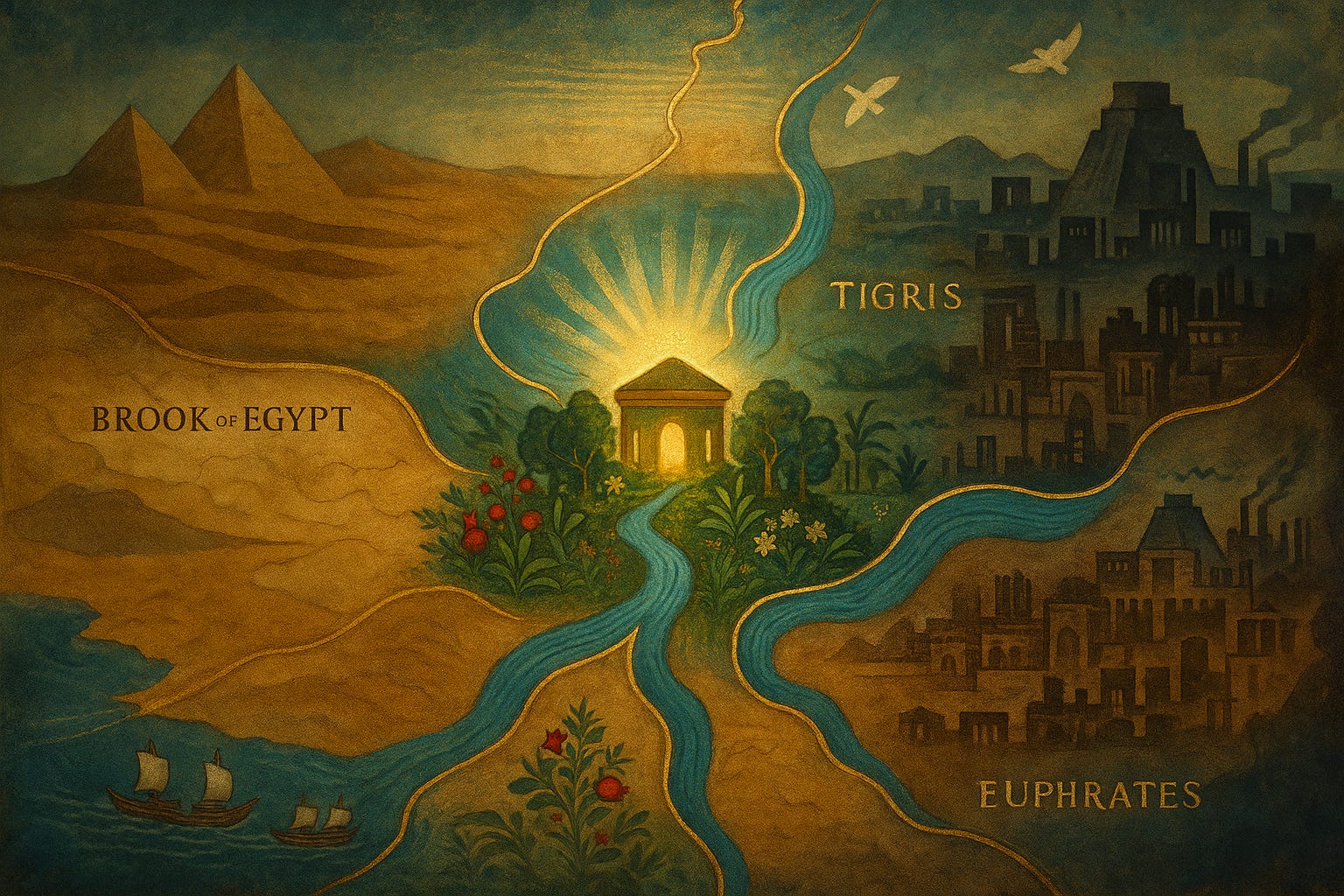
The Bible frames space to teach vocation. Eden’s rivers mark blessing flowing out; Abraham’s land is a bordered micro-Eden where God’s Presence orders public life so blessing can flow out again.
This is the second installment of a series exploring the Bible’s “anti-Edens”—places that promise Eden’s gifts (life, beauty, security, abundance) while resisting Eden’s God. Each installment traces a place’s canonical profile (geography, economy, cult, and politics), shows how God unmasks and redeems its logic, and then offers concrete practices for discipleship.

All Bible quotations are from LSB (Legacy Standard Bible) except otherwise stated.
The beginning
The creation account in Genesis 2 makes a pause from narrating God’s creative acts to give us details about a river that broke into four — after which it continues the creation story1.
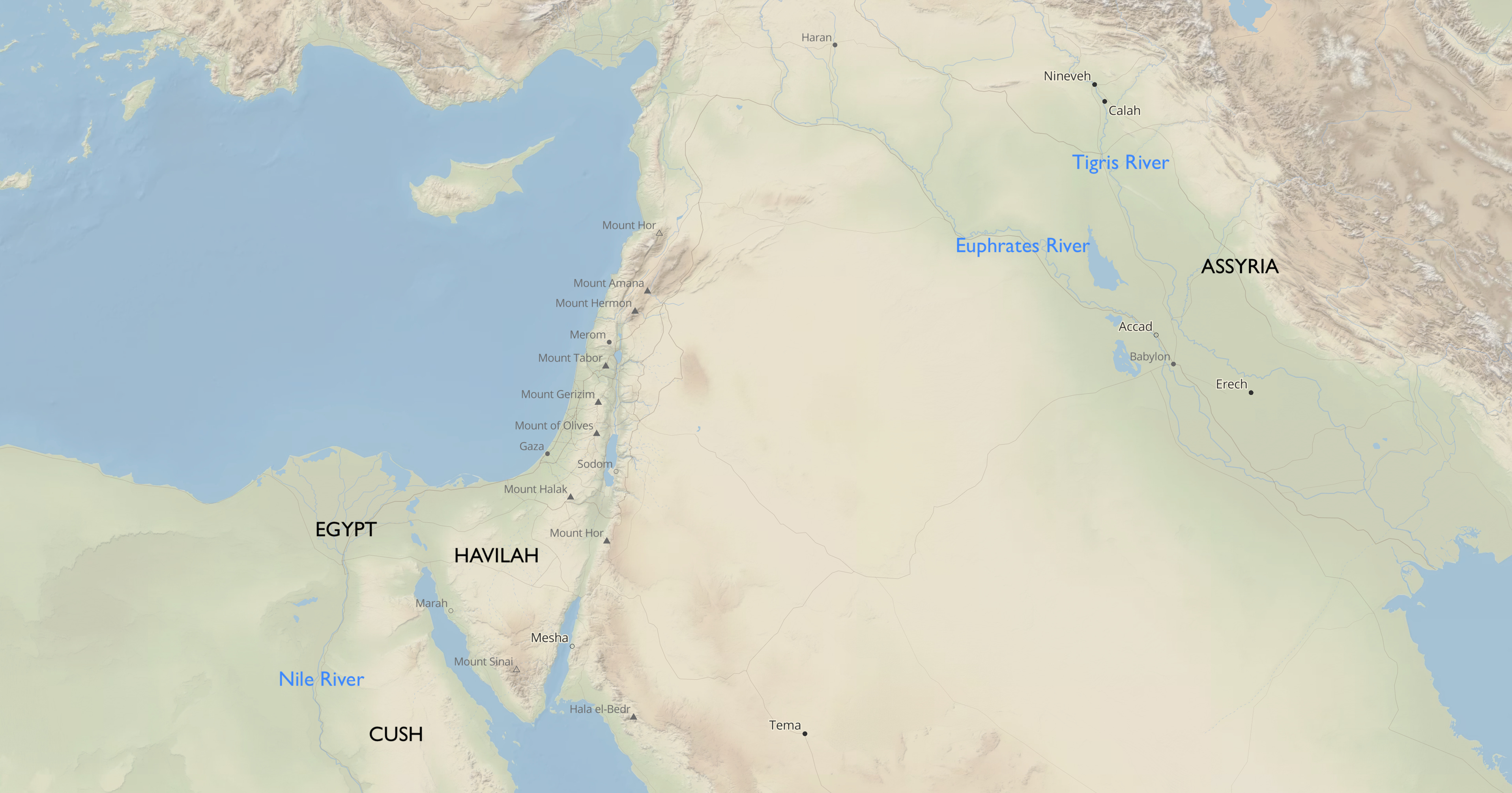
Genesis 2 portrays a single river flowing out of Eden that divides into four:
The Tigris, which runs “east of Assyria,”
Euphrates, the principal river of Mesopotamia/Babylon;
Pishon, which “encircles the land of Havilah”—often placed in or near northwestern Arabia; and
Gihon, which “encircles the land of Cush,” usually understood as Nubia/Ethiopia south of Egypt (sometimes identified with the Nile, though that is debated).
The narrative frames the world beyond Eden by naming rivers that flow out from God’s dwelling and water key regions. The point is not merely geographical but more importantly theological — it is the first picture we have of ordered life flowing outward from the Presence.
The promise
As the storyline continues, Adam & Eve rebel against God and are exiled from the garden as a result. The narrative narrows to Abraham, to whom God promises a land for his descendants.
On that day Yahweh cut a covenant with Abram, saying, “To your seed I have given this land, From the river of Egypt as far as the great river, the river Euphrates
— Genesis 15:18
Genesis 15:18 doesn’t reproduce Eden’s river geography, but it approximates Eden’s world-edges—from Mesopotamia (the Euphrates) to Egypt’s frontier (the “river of Egypt”2)—to mark Abraham’s descendants’ land as a micro-Eden of covenant presence. Both texts use rivers to frame a God-ordered sphere where life with Him is enjoyed and extended—Eden by outflow (rivers watering the world), and Israel’s land by boundary (a defined domain of justice, wisdom, and worship).
This idea is made more apparent as we read of God’s dealings with Israel. God’s covenant with Israel is framed by two complementary institutions: the Tabernacle and the Law. The Tabernacle answers where God dwells—in the midst of His people; the Law answers what His nearness looks like—a social order of justice and wisdom that makes His Presence intelligible to the nations, bringing divine blessing to them3.
“And let them make a sanctuary for Me, that I may dwell among them.
— Exodus 25:8
“You shall keep and do them, for that is your wisdom and your understanding in the sight of the peoples who will hear all these statutes and say, ‘Surely this great nation is a wise and understanding people.’ “For what great nation is there that has a god so near to it as is Yahweh our God whenever we call on Him? “Or what great nation is there that has statutes and judgments as righteous as this whole law which I am setting before you today?
Deuteronomy 4:6-8
Read this way, Israel’s land is a micro-Eden: Eden is marked by outflow (rivers watering the world), while the promise is marked by boundary (a defined sphere where God’s Presence, law, and wisdom take public shape for the sake of the nations).
The unrealized ideal
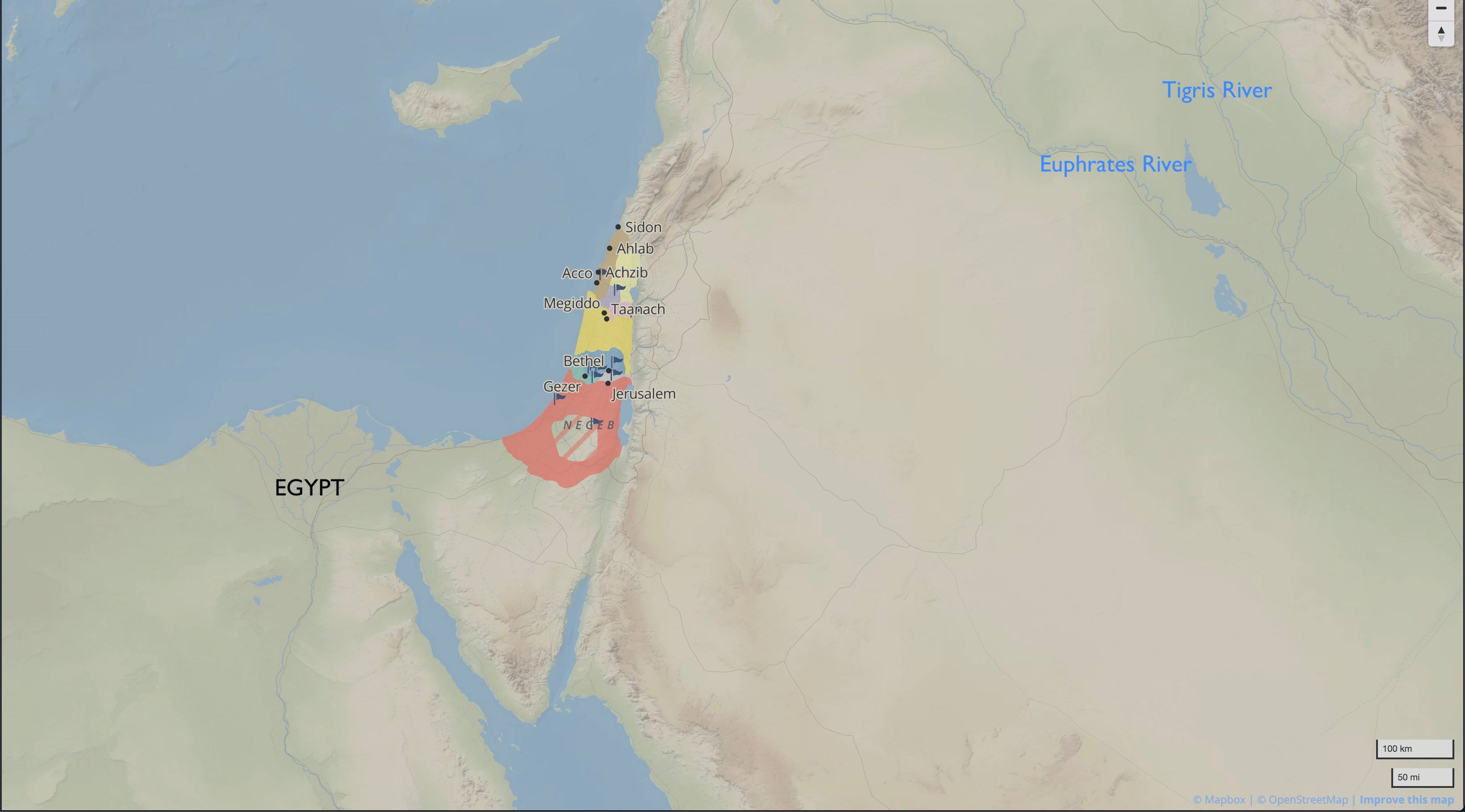
Although God promised a domain “from the river of Egypt to the great river, the Euphrates”, Joshua’s campaigns secured the heartland without finishing the task: significant pockets remained4, and several tribes could not (or would not) drive out entrenched populations5.
Judges opens by cataloging those failures and interpreting them as covenant infidelity6. As Israel “does what is right in its own eyes,” enemies reclaim ground and press Israel back—the Amorites hem in Dan, Midian and Amalek ravage the land, Ammon bites from the east, and the Philistines dominate the coastal plain7. The result is a contracting, unstable border: geography follows theology until repentance and faithful leadership recover space again.
A new Eden/Adam
The narrative of the people of Israel peaks at the arrival of King Solomon. Solomon is cast in strikingly Adamic terms:
He asks for, and is given a “listening heart to judge… and discern between good and evil”8 —a royal wisdom that echoes Adam’s vocation. He orders Israel’s life with wisdom that does not define good and evil on its own terms.
His reign expands “from the Euphrates to the border of Egypt”, approximating Eden’s world-edges9
His encyclopedic speech about “trees… beasts… birds… creeping things… and fish” echoes Adam’s creaturely stewardship10.
The nations stream to hear his judgments, hinting that royal wisdom can mediate blessing outward—the human task in Genesis now exercised from a throne in Zion11.
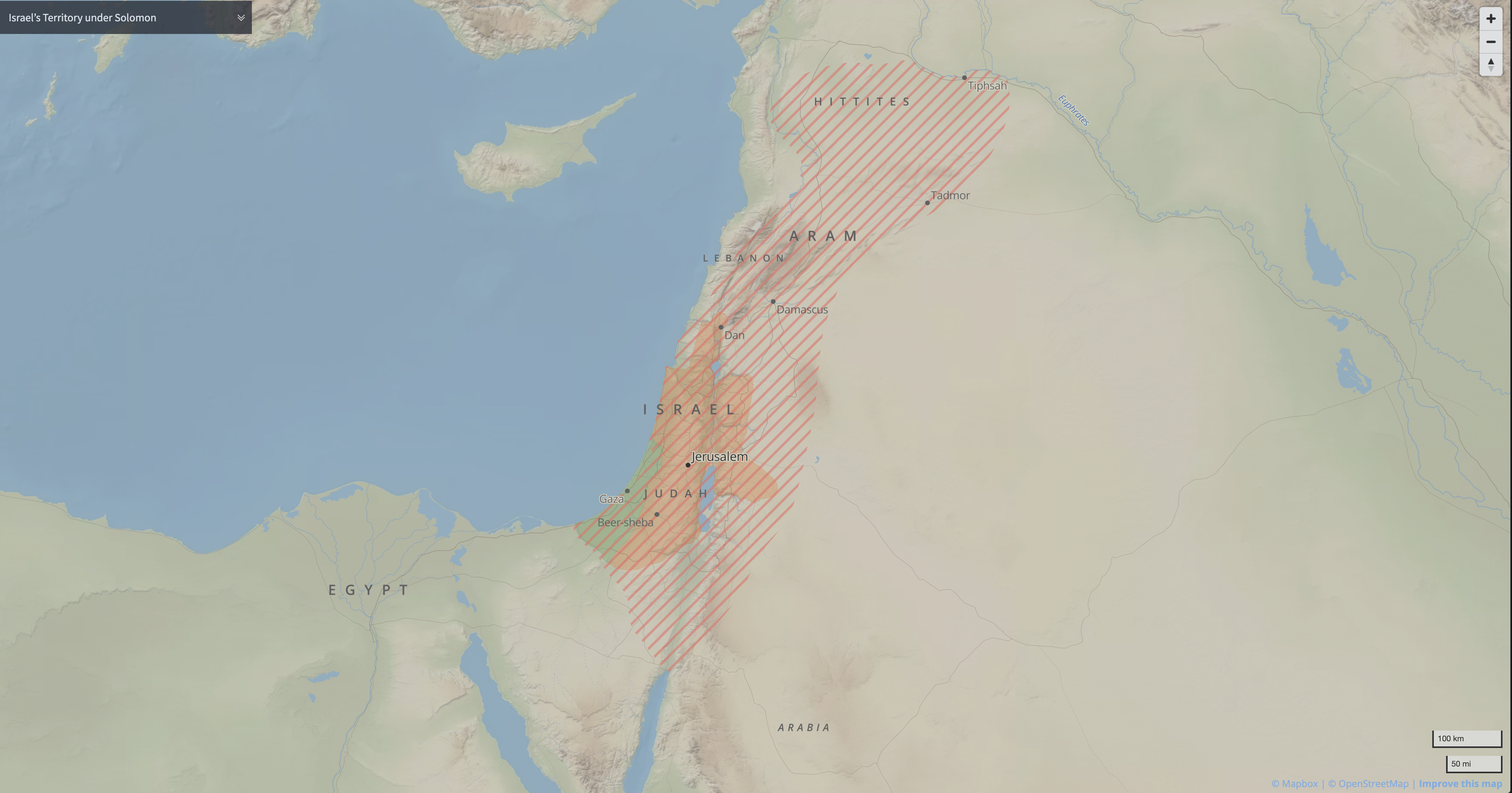
Under Solomon, Israel briefly takes on the shape of a new Eden.
Solomon builds and dedicates the temple, which concentrates God’s Presence at the center
The temple’s décor is a garden-cosmos which echoes the garden of Eden: carved cherubim, palms, lilies, and pomegranates; a bronze “sea” and basins like tamed waters; lampstands like flourishing trees12.
With glory filling the house and “Judah and Israel living in safety, every man under his vine and under his fig tree”, the land reads like tended sanctuary-ground13.
Yet the idyll is short-lived. Solomon’s multiplication of gold, horses, and wives transgresses Deuteronomy’s royal safeguards 14, idolatry erodes the center, and forced labor returns Egypt’s logic to Israel 15. The logic of Egypt had infiltrated Israel’s success. Empire logic had eaten covenant achievement from the inside. The end result is exile.
In Solomon’s story, the ships of Tarshish get a worthy mention. Solomon’s wealth swelled through a fleet of “ships of Tarshish”16. In the prophets, Tarshish becomes shorthand for maritime abundance and human pride17, and in Jonah it names the escape corridor that bankrolls flight from God.
Put together, Tarshish is a symbol for resource streams that can fund false Edens: wealth circuits that can build temples and palaces yet, without obedience, quietly underwrite idolatry and self-security. Solomon’s turn shows the danger—abundance without allegiance bends even Eden-imagery toward a polished Nod.
From maps to Presence
The Bible’s repeated lesson is that maps cannot secure what only Presence can sustain. Nod and Egypt promise permanence—walls and warehouses, quotas and chariots—but they purchase stability by coercion and idolatry, and they inevitably devour the vulnerable. Israel’s vocation is different: to be a people whose public life flows from communion with God, whose justice protects the weak, and whose leaders are under Scripture rather than above it.
That vision does not deny material goods or civic order. It locates them. In the economy of the kingdom, expansion—territorial or otherwise—is not a trophy; it is a trust. When borders widen, we ask: What logic is animating this growth? Whom does it serve? Does it cultivate life with God and neighbor, or does it demand a new quota of bricks?
For the church, the temptation to build Pseudo-Edens persists. We chase the metrics of empire—bigger, faster, louder—and call them blessing. We can even ask for a king “like all the nations,” whether in politics, platforms, or personalities. Scripture’s response is bracing and hopeful:
Bracing, because God will dismantle cities—even ours—when their logic contradicts His character. Lawsuits still land; glory still departs.
Hopeful, because God’s judgments are often severe mercies. He unmakes what we trust in order to re-make us for Himself. He restores borders we did not deserve so that we might return to the Face we had neglected (more on this next week).
What, then, marks an anti-Nod community? Not the absence of structure or technology, but their conversion: tools turned toward neighbor-love, policies that guard the poor at the gate, leaders tethered to the Book, worship ordered around the Presence rather than the platform. In short, people who refuse to stabilize life by coercion and instead cultivate life by communion.
Prayer
Lord of the garden and the city, we confess how easily we trust walls, platforms, and ships of Tarshish—resources without allegiance, abundance without obedience. Have mercy on us.
Center us again in Your Presence. Give us a new heart and a new spirit. Tether our leaders to Your Word; teach us to steward power as service.
Make our homes and churches micro-Edens— places where Your nearness is felt, the poor are protected, and blessing flows outward beyond our borders. Uproot Egypt’s logic in us; undo the polished Nod we try to build.
Lord Jesus, cleanse our worship, and reorder our loves. Amen.
Next in the series: Pseudo-Edens, Part 3 — Ruin and Redemption
In this installment we tracked the arc through borders—how Solomon’s map briefly brushed Eden’s edges, and how Egypt’s logic hollowed that achievement.
Next, we’ll track how Jonah’s prophecy under Jeroboam II reframed border restoration as mercy, not merit.
Genesis 2:10-14
Many identify this boundary with Wadi el-ʿArish (the brook of Egypt) rather than the Nile.
“In you all the families of the earth will be blessed” - Genesis 12:3, 22:18, 26:4, 28:14
Joshua 13:1–7
Joshua 15:63; 16:10; 17:12–13
Judges 1, 2:1–3, 10–15
Judges 1:34, 6, 10-11, 13-16
1 Kings 3:9
1 Kings 4:21, 8:65
1 Kings 4:33
1 Kings 4:34, 10:1-10
1 Kings 6-7
1 Kings 4:25, 8:10-11
1 Kings 10-11, Deuteronomy 17:14–20
1 Kings 9:15
1 Kings 10:22
Isaiah 2:16; 23; Ezekiel 27
This sounds a lot like the article on courage a friend of mine wrote.
Solomon’s example is particularly striking. To think the one who asked God for wisdom could fall into idolatry and debasing of self is a stark reminder.
Reminds me that the law starting with our duty towards God is the anchor in which we value our neigbours and communities (Gods image bearers).
Thank you again!